
 Thought Gleam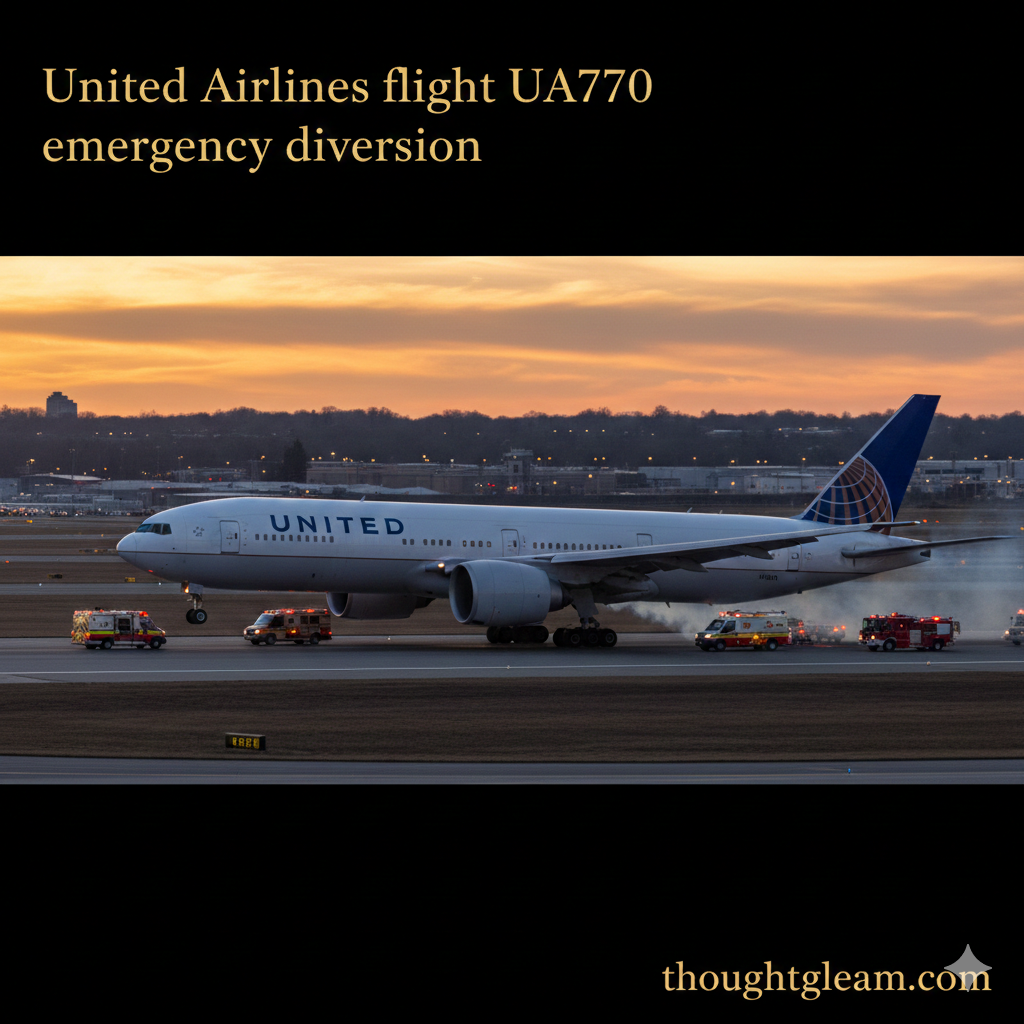
The air transport is regarded as one of the safest transportation in the world. There are safety regulations, high tech and professionals who make sure passengers are safe daily. Nevertheless, there are still possibilities of the emergence of an emergency. Once they do so, the airlines engage in elaborate procedures to ensure that everyone is safe. An example of such an event that attracted the attention is the United Airlines Flight UA770 emergency diversion.
The article presents an in-depth and comprehensible explanation of the United Airlines Flight UA770 emergency diversion. We shall discuss what an emergency diversion is, what has probably occurred in the flight, how the crew reacted, what passengers went through and what the aviation industry can learn out of this situation.
What Is Aviation Emergency Diversion?
Emergency diversion occurs when flight alters the route that is intended and arrives at another airport than it was supposed to be. This ruling is arrived at when the continuance of the flight will present a danger to the passengers, crew members or the aircraft.
Typical causes of Emergency Diversions.
Diversions could be emergency as a result of:
- Any mechanical or technical problems.
- Health incidents among the passengers or crew.
- A smell or air in the cabin is unusual.
- Weather-related threats
- Security concerns
The case study of United Airlines Flight UA770 offers a summary of its events and circumstances.
United Airlines Flight UA770 was a flight on a scheduled commercial flight when it suddenly happened that an unexpected incident would happen in the middle of the flight. This made the flight crew resolve to make an emergency diversion in order to guarantee the safety of passengers.
In spite of the fact that United Airlines flights are performed under the conditions of rather rigorous safety systems, even some slight warning signals can cause the emergency procedures. The crisis United Airlines Flight UA770 emergency diversion shows the responsiveness of airlines in case of not doing everything as intended.
History of the United Airlines Flight UA770 Emergency Diversion.
The following is a rough chronological sequence of how such an incident would occur.
1: Normal Departure
- Flight UA770 was on time.
- First climb and cruising altitude had been met.
- This is a normal start of cabin service.
2: Detection of an Issue
- Cockpit instruments/sensors identified a non-standard situation.
- Pilots consulted warning indicators.
- Cabin crew was informed
3: Crew Assessment and Decision
- Standard operating procedures were used by pilots.
- Checklists were used to evaluate the situation.
- The air traffic control (ATC) was notified.
4: Emergency Diversion Initiated
- The location of a local appropriate airport was chosen.
- Passengers were notified in a non-alarmist way.
- Cabin crew was ready to land the cabin.
5: Safe Landing
- Aircraft landed safely
- There were standby emergency services.
- Passengers got out or waiting on the board.
Potential Reasons leading to the Emergency Diversion.
Airlines do not necessarily provide full technical information at once. Nevertheless, according to aviation standards, the United Airlines Flight UA770 emergency diversion could have been one of the following aspects.
Mechanical or Technical Alert
Present day aircrafts have sophisticated sensors. Even a small alarm signal in the system may need urgent action.
Cabin-Related Concerns
Diversions can be caused by issues like smoke smells, irregularities in air pressure or electrical malfunctions.
Medical Emergency
In case a passenger or crew member needs emergency treatment, the pilots can divert to the closest airport.
The way the Flight Crew responded to the situation.
During times of emergency, professional training becomes extremely important.
Pilot Responsibilities
- Monitor aircraft systems
- Communicate with ATC
- Follow emergency checklists
- Ensure a safe landing
Cabin Crew Responsibilities.
- Keep passengers calm
- Provide safety instructions
- Secure the cabin
- Assist passengers after landing
The crew handling the United Airlines Flight UA770 diversion demonstrated a high level of coordination and composure, achieving a successful outcome.
Diversion Passenger Experience.
When a sudden event occurs, passengers usually get anxious, and airlines train their crews to reduce fear
What the Passengers Must have Felt.
- Clarity in the announcements by the captain.
- Flight attendant calmness.
- Slight delays after landing
- Rebooking or accommodation service.
United Airlines is normally supportive like meals, hotel accommodations, or other post-diversion flights.
Safety Measures Observed in Emergency Diversions.
Regulatory authorities enforce stringent safety regulations on the aviation sector all over the world.
Key Safety Measures
- Real-time contact with air traffic control.
- Clearance of emergency landing.
- On standby; ground emergency teams.
- Inspection of post landing aircraft.
All these measures assure safe endings of all emergency diversion.
Comparison Comparison of Emergency Diversion and Normal Landing.
| Feature | Emergency Diversion | Normal Landing |
|---|---|---|
| Reason | Safety concern | Scheduled arrival |
| Route Change | Yes | No |
| Emergency Services | On standby | Not required |
| Passenger Impact | Delays and rerouting | Minimal |
| Crew Procedures | Emergency checklists | Standard procedures |
Air Traffic Control (ATC) Role.
The Emergency situation involves the Air traffic controllers.
ATC Support Includes
- Clearing airspace
- Prioritizing the aircraft
- The organization of emergency services.
- Getting the aircraft safely to landing.
The ATC coordination in the United Airlines Flight UA770 emergency diversion would have played a crucial role toward a successful and safe flight.
The Post-diversion Aircraft Inspection.
Once the aircraft lands on the field, the team thoroughly examines it.
Inspection Steps
- Engineers consider the issues.
- Technicians repair or substitute malfunctioning parts.
- Technicians complete safety checks.
- Aircraft undergoes clearance before they go back to service.
This would guarantee that someone checks the airplane for safety before it flies again.
We have used this incident to provide some valuable insights.
All aircraft accidents teach us a lot.
Key Takeaways
- Safety mechanisms perform as designed
- Early alerts stop disastrous accidents.
- Crew training saves lives
- Passenger cooperation is important
The incident of the United Airlines Flight UA770 emergency diversion supports the need to make preventive safety moves.
The United Airlines Emergency situation management.
United Airlines abides by the international flying laws.
Airline Emergency Policies
- Uncompromising maintenance schedules.
- Continuous pilot training
- Regular safety drills
- Transparent communication
These policies avert distrust and insecurity.
Press Response and Media notation.
Emergency diversions tend to draw the interest of people. Though it might be a disturbing development, this often shows that the safety measures are working well.
Media reports on the United Airlines Flight UA770 emergency diversion created awareness about airline safety protocols
FAQs: 2008 United Airlines (Flight UA770) Emergency Diversion.
What is an emergency diversion?
Emergency diversion is when an aircraft lands in another airport because of some safety reasons.
Was anyone hurt in the incident?
The landing of the flight was safe with no reported injuries.
Are emergency diversions common?
Is the problem of emergency diversions prevalent?
They come about very uncommonly in commercial aircraft.
Do people still believe flying is safe after such accidents?
No, the sky is as safe as it could be because of high safety measures.
Is there compensation to passengers?
Paying is based on policy of the airlines and local laws.
The reason why Emergency Diversions would give an indication of safety.
Pilots act cautiously and avoid unnecessary risks. One example of responsible decision-making is the case of the United Airlines Flight UA770 emergency diversion.
Conclusion
The incident of the United airlines Flight UA770 emergency diversion illuminates the interaction between modern aviation safety systems to safeguard the passengers. From identifying possible problems at an early stage to ensuring a safe landing and conducting post-incident checks, the crew followed strict safety rules at every step.
Although unplanned diversions may be inconvenient, they show that the airline cares about the safety. Such accidents remind us that aviation workers train to handle emergencies calmly and effectively.
After all, emergency diversions are not the failure, they are evidence that safety should be a first priority at all times.